
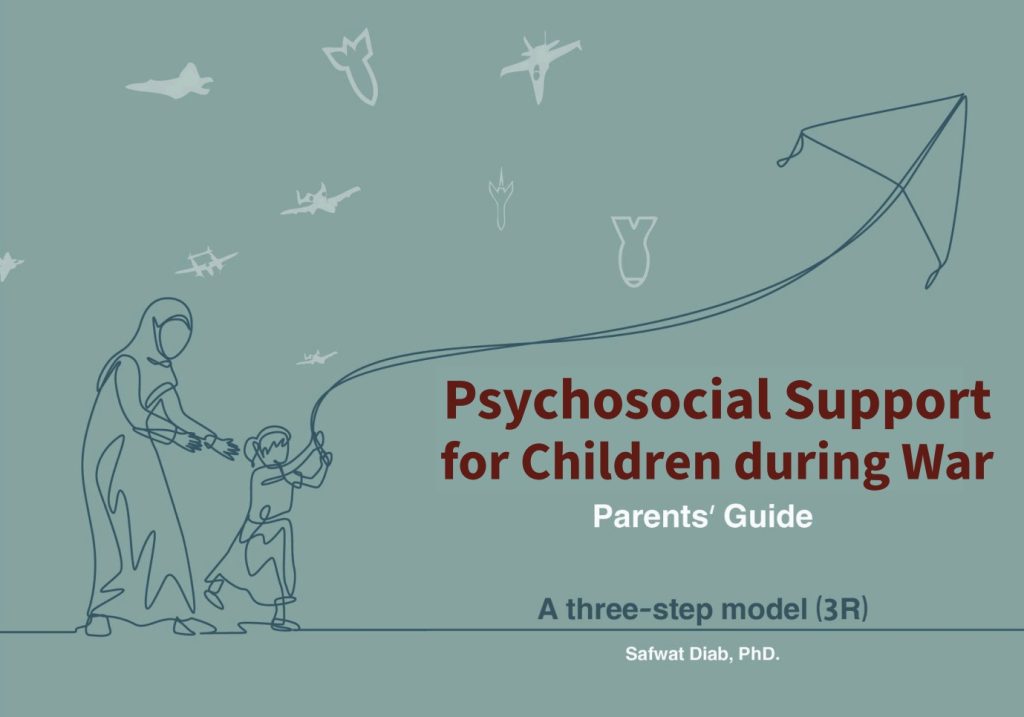
Authored By:
Safwat Diab, PhD. Specialist and Researcher in Education and Psychosocial Health of War Traumatized Children
In Cooperation with:
Nora Sveaass, Clinical Psychologist,Professor Emeritus
Helen Christie, Clinical Child Psychologist
Beate Seibt, Professor Of Social Psychology
Katrin Glatz Brubakk, Clinical Child Psychologist
Elisabeth Ng Langdal, Cand. Polit in Human Geography
Dear parents and family members, the horrific war events that your family and the whole community are undergoing impact everyone. The most affected are the children, as their ability to understand, interpret, and deal With such painful experiences is not yet as strong as that of an adult. War threatens children’s sense of security and enjoyment of life, and they may show signs and reactions indicating that they are affected. They now need all the support they can get to protect their mental health.
Psychosocial Support for Children during War
Common reactions by children to trauma
why and how this guide works
things to remember as a caregiver
Below is a list of common reactions exhibited by children who are impacted by war trauma, some of which you may have observed in your own children. Keep in mind that these reactions may vary from child to child, but they are all normal reactions to the harsh, inhumane events you all are experiencing. Although some of these reactions may be disturbing to you, they also indicate the children›s attempts to regain balance and protect themselves from the pain caused by war. Common reactions may include:
- nervousness, jumpiness, fears, worries, anxiety
- withdrawal, depression, fear of going outside, loss of interest in doing things
- crying easily, getting easily upset, clinging to parents
- irritability, easily becoming angry, temper tantrums, restlessness, rapid mood changes
- concentration and sleeping difficulties, nightmares, absent-mindedness
- not wanting to play, avoiding peers or siblings
- acting younger than their age, losing abilities they previously possessed
- fear of death of a family member, fear of their own death
The children are in dire need of protection and support from their parents and families to adapt, recover, and grow/ develop properly. This guide has been prepared to help you as parents or other caregivers, during these difficult times, so that you help the young children in the family to cope with the horrific events of war and prevent them from developing more severe problems. You are the most important persons in the children’s lives, and children in your care perceive you as their primary source of support and comfort. You can facilitate their healing process and strengthen their psychological resilience.
This booklet provides information, practical suggestions, and examples of things you can do to help children overcome negative reactions, feelings, and thoughts after being exposed to traumatic war events. This guide presents three sets of practices: Restoring a sense of security, Responding to the child’s thoughts and fostering a feeling of control, and Rebuilding hope for the future. Many of these suggestions are familiar to you as they are part of common parenting behaviors. You can practice these suggestions and activities in your family’s daily life, even under the harsh conditions of war and displacement.
By observing your fear through body language, facial expressions and tone of voice, your children can easily sense when you are feeling unsafe; and, accordingly, they feel fearful and unsafe as well. This happens because they perceive that the world is not safe when you are not able to protect them. So, remember that you are the most important source of the sense of security for your children. You are the protective shield that can provide them with this feeling and prevent them from developing traumatic reactions.
It is expected that you are also deeply impacted by the atrocious events, and it is normal that you are unable to hide that. Therefore, it is very important to be aware of your own reactions and acknowledge that you may need help as well. You should do what you can to calm yourself down and regain control as quickly as possible. This will, in turn, help your children to learn and develop the ability to regain control. It will also help them to recognize that the protective shield can still protect them. Simply taking a look around you and seeing that your children/family are with you can help you to calm down, which will give you a great deal of reassurance and energy to care for them. Taking some deep breaths, drinking some water, saying a prayer or hugging someone will help you calm down. This will allow you to practice your parenting role in supporting your children, which will give you additional power as a caring parent.
You should also remember that such harsh conditions of horrifying war, loss of loved ones, lack of basic necessities, and facing many living challenges over time can create tensions in the relations with your children. These conditions may make you less patient, more nervous and more intensely angry towards your children than usual. You may therefore act in a more violent way with them without being aware of it. So it is important to realize that the war and its consequences are neither your fault nor your children’s. All of you are victims of these conditions and need support and help.
As noted, your children seek support and protection from you and expect you to see and recognize their suffering, to feel empathy with their pain, to hear their worries, and to comfort them so that they feel safe again. You are able to do a lot to help them feel safe, get rid of disturbing thoughts, and regain hope for the future. You also need to remember that reactions after exposure to war trauma may differ from one child to another. Observe your children after the traumatic event or at any given moment to see who needs your help most.
Below, we provide you with a practical three-step guide based on normal, everyday parenting behaviors, to help you understand, support, and handle your children during wartime. Following these suggestions will reduce the war’s impact on your children and protect them from developing more severe problems later. You can integrate these steps into the ongoing daily care of your children. So, it is important to follow the three steps in sequence and choose the most appropriate activities under each step according to the child’s age, the time of day, and the situation at hand.
First: Restoring a sense of security
Second: Responding to the child’s thoughts and fostering a feeling of control
Third: Rebuilding hope for the future
(Try these activities in sequence)
Provide a sense of protection and assure safety: Look at your children and see who is the most terrified, give him/her a tight hug for some time while repeating reassuring phrases, such as: “you are fine, you are safe, we are safe, I am with you and protecting you, do not worry”. Allow the child/children express their fear by crying or trembling, this is a normal reaction in such situations. Try not to pressure the child to stop crying by either asking or shouting at him/her. Just stay close to him/her and say with a gentle voice words like: “you are brave, you are strong, you are not alone, we will all be fine”. If more of your children show the same reaction, a group hug will work as well. Together with another adult or an elder sibling, put the children in the middle and surround them with your hug for some time while using reassuring words that they are all fine and safe. Continue holding and reassuring them until the children calm down. When you release your hug, confirm to the children that all of you are well and safe by saying, “look around, all of us are here and we are all safe now”.
If a family member is absent at the time of the event, it’s natural for everyone to feel worried about him/her. Your role is important here in alleviating the family’s worry about the absent person by reassuring everyone that he/she will be fine and will return soon. Despite the difficult situation, calm yourself down with deep breathing, or in your own ways, so that your worries are not passed on to the children.
Calm the children and family: After achieving some sense of security and calmness, you and the children may perform a deep breathing exercise. This can be done by inhaling air through the nose while blowing up the belly softly like a balloon, then slowly exhaling air through the mouth. Repeat this up to five times to achieve greater relaxation. It’s good to perform the same breathing exercise as a family by interlocking hands of the family members in a circle with eyes closed. As an alternative to the breathing exercise, you can practice other familiar and desired rituals for the group while interlocking hands, such as saying religious phrases or singing a children’s song, which may bring a great sense of comfort, peace, and tranquility.
(Apply what you think is relevant from the following activities)
Respond to questions: Once the situation is calm again after the event, it is expected that the child/children may ask questions about what has happened; where and why, among other things. This is also a normal reaction in their attempt to understand the situation, and may help reduce their anxiety and tension. It is important and useful to respond to their questions because this helps them regain stability and balance.
While sitting with the children around you, give them a chance to freely ask and share their thoughts and feelings. Spend some time answering their questions simply and honestly by telling only the information they ask about, without giving too much information and without leaving any doubts about the event. At the end of this gentle talk, reassure them of their safety and tell them that you will always take care of them. You can also give the children a chance to present their own explanations and interpretations of the event and can then provide clarifications based on the information you know about what has happened. This helps them form a reality-based understanding of the event that may contribute to the regaining of emotional stability and balance necessary to recapture control.
It’s important to know that if children don’t get answers to their immediate concerns, they may construct their own imaginary version of what has happened. This may lead to their being trapped in an unhealthy thought process, where the imagined scenes can be more damaging than the actual event itself. Also, remember that it’s not advisable to deny what the children themselves have seen and heard because it may confuse them and make them lose trust in their own senses, in you, and in others.
Distract negative thoughts through a pleasant memory: After answering the children’s questions, now remind them of a pleasant shared experience from the past and recount it to them as a complete story with a sequence of events in an amusing and entertaining way. As you are telling the story, try to emphasize and describe each child’s role in the experience; for example, describe the setting, the nature of or reason for the event, who were present, what clothes they were wearing, what they said, did, ate, and perhaps how it tasted. Get into as much detail as you can to immerse the child/children in the experience with their own imagination and to retrieve the positive feelings that the pleasant memory from the past evokes. Try your best to make the narrative enjoyable, vivacious and funny by using a cheerful and expressive tone of voice and acting out scenes with facial expressions, gestures and movements in a joyful way. While you are presenting the narrative, allow the children to participate by asking explanatory and exploratory questions or telling what they remember from it. Be sure to respond to questions with as much detail as you can. When the children participate in recounting the previous experience, they are immersed in the story, which means that their positive thoughts and feelings have won over the painful memories of the terrifying event.
In case it is difficult for you or the children to remember a shared pleasant past experience, you can use one from your own life (e.g., a trip with your family during your childhood) or you can make up a fictional story with enjoyable content and a happy ending. You can also ask the children to remember and share a pleasant past event with the group. Your role here is then to encourage and help the child to construct the narrative by asking prompting questions that help him/her to retrieve and talk about the details; for example, how was the weather, who was there, what clothes he/she and other children were wearing, what did he/she say and do, what did he/she eat. The aim of this is to create a pleasant atmosphere, build the narrative together as a group and get to the closing with a happy ending which, consequently, will outweigh the painful memories of the terrifying event.
Remember that you can practice “the pleasant memory activity” anywhere and at any time of the day or night, also while in bed. This activity is useful at all times, even if there is no specific terrifying event, as it relieves the general stress caused by war conditions and provides a sense of comfort that helps the child to regain control and hope.
Direct thinking towards a positive mental task: To engage the child/children in a pleasant thought process rather than the painful event, you can organize a round of simple puzzle-solving and riddles with short wording and reasonable difficulty appropriate for the child/children age. However, it is important to present the puzzles and riddles in a joyful, enticing and exciting way. In solving the puzzles, the children may compete, work together, or take turns making sure that each gets a chance. You may create puzzles or riddles about fruits, vegetables, food, birds, animals, science and math, or anything that comes to mind. Give the children a chance to present puzzles or riddles to the group as well. It is also possible to practice other similar enjoyable activities, such as telling jokes, creating word-chain games (finding a word that starts with the last sound of the previous word), and other joyful activities that you know.
Direct thinking towards a positive practical activity: To distract children’s thoughts away from the painful event, you can involve the children in doing something practical, as individuals or in a group. For example, you can ask them to organize the place where you are staying, to help prepare food, to take care of and sing to a younger sibling, to read schoolbooks or any available stories, or do any other practical activity. Consider that after exposure to war trauma, children may avoid doing things that they used to do before. This is normal and to be expected. So you should accept this and suggest a different activity that they are able to do.
Direct thinking towards a positive psychosocial activity: You can also encourage the children to play a group game that they know. Remind them of one that they were playing before the war or teach them the games that you played during childhood. They may play in pairs or as a group and you can play with them. Your choice of play depends on the tools or materials available, but there are many games that do not require ready-made materials or that may use materials made with simple things available in the environment. Retrieve memories from the days of your childhood and you will probably remember many such games. The most important thing here is that the children play together as it relaxes them and brings the group or family closer together, which is very supportive to their mental health.
(Apply the following activities in sequence)
Helping the child/children to rebuild hope for the future may wipe out the remaining negative feelings and strengthen resilience. Achieving this depends mainly on retrieval of positive past memories. However, it is important that the helping process realistically takes into account the changes that the war has caused in their lives. Depicting future prospects too idealistically may cause harm to the child later, when confronted with a different reality.
Assure that the suffering will end: Tell the child/children that, “this situation will come to an end, many people and countries are working on it and the situation will be safe again for all of us soon”. Use your skills to assure them that the war will end for certain, even if it takes a while.
Retrieve pleasant past memories: Remind the child/children about how life was before the war, motivate them to retrieve what they remember about that time and to talk about it. Then let them imagine that this is how it will be after the war. Try to remind them about the details related to how the life of the family was in the home, neighborhood, school and market. Encourage and give the child/children the chance to talk about and share their experiences freely. At the end of this talk, assure them that you will go back to doing the same things and will enjoy life together again. Encourage them to imagine the situation as it will be when they have a proper home again and to talk about the things they intend to do after the end of the war.
Establish realistic expectations and build hope: It is essential that you tell the child/children enough information about the damage that has happened to their home, schools and/or neighborhood, so that they may construct realistic expectations. At the same time, reassure them that you will rebuild what is destroyed together, that life will return to normal and you will enjoy it together again. Here, you may also recall some difficult experiences you have gone through in the past and show how you were able to overcome them together.
Now, after you have gone through the above steps in the process of helping the child/children, it is crucially important to monitor and see if any of them is still irritated or uncomfortable. You can determine this by observing their body language, facial expressions, tone of voice and breathing rhythm. If any of them is still irritated, make sure you do not leave him/her alone in such a stressful situation. Instead, help him/her to achieve stability and regain balance. You can do this by bringing this child closer to you and gently touching or rubbing his/her head, along with giving hugs and kisses. Tell the child that you understand and feel his/her suffering, and that you are always there for him/her. This, in turn, will help the child to stabilize and regain balance and control.
Important comment:
We would like to point out that while you are working with your child(ren), and before you have completed all the activities in the three steps mentioned, they/he/she may feel comfortable and want to go play and interact with each other or with other friends. This is normal for children and is a good sign that you have succeeded in making them feel safe again and regain a sense of control. Therefore, we emphasize that there is no need to force them to stay and finish the remaining activities in the three steps. Instead, simply allow and encourage them to do other activities as long as the area is safe again. Engaging children in social and physical activities with other children will greatly help them to release tension, regain control, and build their psychological resilience as part of the healing process. This is a valuable opportunity for natural recovery that you should encourage.
Special issues and important considerations:
Encouraging natural recovery through social interaction
Encourage the child/children to reconstruct their social network and establish new social relations with other children in the surrounding area. Allow and encourage them to participate in the available social and sports activities. This will promote a feeling of security and control, and will increase the chance of natural healing and recovery.
Daily follow up and care
Watch your children’s behavior regularly and be attentive for any signs of fear and anxiety, such as being clingy (especially young ones), stomachaches, headaches, nightmares, sleeping difficulties and intense grief or anger. These reactions indicate that the child is still suffering and needs more attention and care. The best way to provide this is to offer the child more of your time, warmth, and love (listening, hugging, kissing) and to involve him/her in some of your own activities. Encourage the children in the family to do things together during the day. It would be very useful to set a time when you as a family can get together on a daily basis, talk and do a group activity (e.g. playing, singing, or telling stories). These meeting times will be beneficial to all family members and will be more useful if it becomes a part of the daily family routine.
Dealing with nightmares
It is common for children to suffer from nightmares in frightening conditions of war. If that happens with any of your children, wake him/her gently and let him/her see that you are there next to him/her. Assure him/her that he/she is safe and that you are with him/her. You can take the child into your bed, embrace him/her, gently stroke his/her hair and sing a lullaby or recite religious text in a soft voice to help him/her fall asleep again. Gently massaging the child will give him/her much comfort and relaxation. You can also ask the child to count from 100 backwards which will help him/her fall asleep again.
In the morning or during the day, you can make it a routine to get together and ask the children to tell their dreams as a complete story, which may also help in recovering from nightmares. While each child is telling his/her dream, ask him/her questions to help him/her fill in the missing parts of the dream story. Then, as the story comes to a close, create a happy ending for the dream together with the child.
Dealing with grief
It is possible that the child or family has lost close relatives or friends in the war. Showing grief is an important part of the children’s developmental process for their future. As a parent, you do not need to hide your sadness and tears from the children, and it is important that the children also express their sorrow and sadness. Your role is essential as you can comfort the child by saying that, “The person passed away (was martyred) and I understand that you are feeling sad about losing him/her.” It is important that you help the children understand the meaning of death, for example, by reminding them that the deceased will not be with them anymore but he/she is in a better place now because he/she died as a victim, and that God is taking care of him/her.
Encourage the children to retrieve and talk about positive memories of the deceased person. You may also ask the children to read religious texts for his/her soul and pray for him/her. Visiting the grave of the deceased person and reading religious texts are very beneficial ways to process grief and sorrow in children and adults alike. Also, encourage the child to talk to the deceased and tell him/her whatever he/she wants, whether it is about his/her thoughts and feelings related to past memories or about his/her current life, which will also greatly alleviate his/her feelings of grief.
Reducing war reminders
It is advisable to reduce family talk about war experiences as much as possible. It is also helpful to prevent children from watching war videos during the day and especially before bedtime. Such talk and video scenes evoke memories of their painful experiences and increase their anxiety and fear, making it harder to fall asleep or sleep well. It is therefore better that family conversations focus on pleasant experiences as much as possible, even during these hard times, which is also beneficial for the family as a whole.
Encouraging practicing talents
Encourage your children to practice their interests and hobbies if they have the tools or materials for such (e.g., writing stories, drawing, reading or gymnastics), whether in your place of residence or in any community center nearby. All of these activities promote natural healing and recovery by reducing anxiety and tension, and thereby help the child to regain control.
Creating daily routines
It is very helpful to assign each child a regular role within the daily family routine, as it enhances control and psychological resilience.
Praising adaptive responses and behaviors
It is important to praise the children when they show adaptive responses, such as helping the family, playing with and consoling siblings, and attempting to concentrate on schoolwork. The child performing such activities is showing clear signs that he/she has overcome the risk and is recovering well. Praise and encouragement for these behaviors nurtures his/her inner feeling of strength, resilience, mastery and competence, and will prevent him/her from feeling helpless.
Constructing your own support strategy
Construct your own support strategy that you may use daily and whenever your child/children need support. In building your own strategy, you can select what seems relevant to the situation at hand from the suggested activities for each of the above three steps, taking into consideration that your strategy should include activities from each step in sequence.
Helping others
Now you know more than others about how to help children in times of war, and you have the interest to help other children. The children of other families in your area may need your help. It would be beneficial to include them with your children when you provide help, and you may also teach other parents how to do the same for their children. This is an important role within our humanitarian responsibility to care for children and we trust that you will not hesitate to do so.
Parental cooperation
We encourage both parents and other caregivers to read this booklet to guarantee a harmonious interaction and cooperation in the care of children.
Useful for other caregivers and care providers
The suggestions in this guide may also be useful for other children’s caregivers and care providers, such as teachers, activity facilitators and child psychosocial care workers. Such caregivers may use this guide with the groups of children they are working with after they have been exposed to horrific and traumatic war events. They may also use the guide to educate parents about psychosocial care during the war.
Seeking additional support
The aim of this guide is to strengthen parents’ knowledge and competence in helping their children to withstand horrific situations, reduce their fear and anxiety, and regain the feeling of safety to prevent them from developing more serious problems later on in life. For additional support when you feel the need, we encourage you to involve your children in the psychosocial intervention groups that are organized in the community centers in the area where you are staying.