
Use of metaphors and stories
Metaphors, stories or images can amaze, inspire or open up new thoughts. They are simple ways and effective tools for teaching and learning as well as therapy.
We introduce six metaphors that can help you in your work.
why metaphors and stories?
five focus areas
importance of appropriate metaphors
Metaphors and stories contain an implicit meaning. They allow people to go beyond the direct narrative of what they have experienced: they create spaces of imagination that help us see what we have not yet seen, through which we can understand the world better and give our experiences meaning. They help us switch between insight and experience and understand our own reactions and experiences. They show us how things are, how things are connected and can be understood. Because they exist outside us, not inside, they can assist us to talk about issues we find difficult to discuss explicitly.
When using metaphors and stories, pay attention to the five focus areas:
- thoughts
- feelings
- breathing
- heart
- body
These are ‘points of entry’ into problems and reactions that often emerge in the life of people who are traumatised. You can mention these in your story or reflect about them with the survivor.
It is very important to choose an appropriate metaphor. Always consider the survivor’s background. For example, the metaphors of the bathing duck and the wooden raft might trigger migrants who crossed the sea in an open boat.
1. The river
Create a coherent narrative.
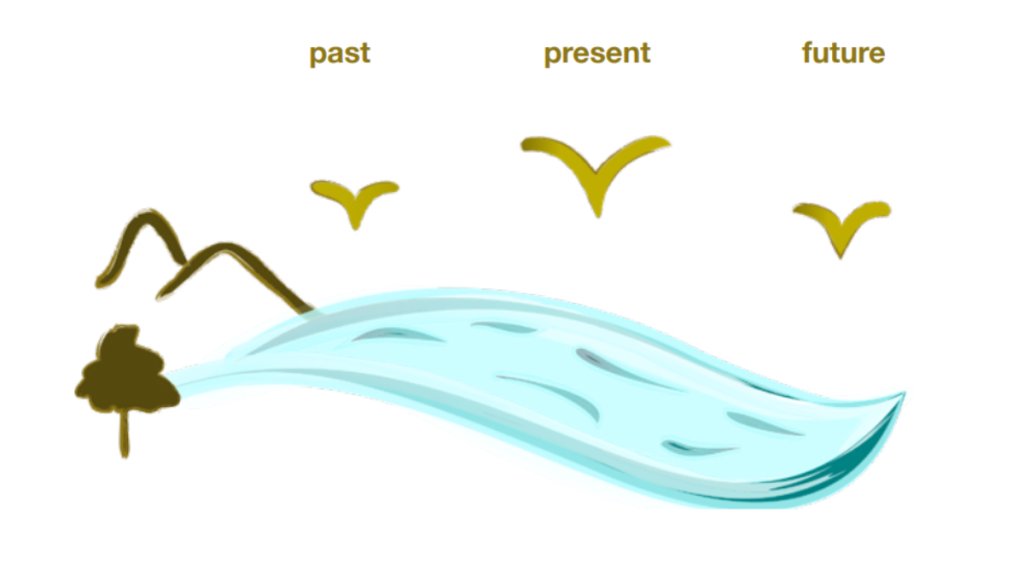
Rivers can be a good metaphor for time and the course of life. A river flows in one direction, from its source to the sea, from cradle to grave, birth to death. Our thoughts and attention are like birds above the river, flying back and forth. We remember good and terrifying things, sorrows but also happy events. Our thoughts also fly into the future, to our worries, what we fear, what we look forward to and long for.
Together, the helper and survivor visualise the river. On one bank of the river, draw symbols or write keywords that represent the survivor’s good memories, the good things of the present, and what he hopes the future will bring.
On the other bank, draw symbols or write keywords that represent sad or frightening things the survivor has experienced in the past, what is stressful in the present, what makes him anxious or worried about the future.
Make sure he draws and writes some things that he longs and hopes for in the future. Encourage him to notice where his thoughts tend to travel.
This exercise can help a survivor see his life as a whole. This may in turn help him to feel that his traumatic experiences do not dominate altogether but can become just one part of his experience, alongside many other memories.
2. The dragonfly
The dragonfly metaphor can help a survivor understand his situation and perhaps improve it. The two wings of the dragonfly symbolise the past and the future. Between the wings represents the present. The survivor can gradually become more present (here and now) and gain more control over his life and his personal resources. The dragonfly’s eyes symbolise his ability to look beyond his traumatic experiences and see hope for the future. By this means, and by remembering good memories from his past, the dragonfly learns to use his wings again to fly. Survivors too should be free to determine their life and move in the directions they want.
The dragonfly metaphor is in four parts: (1) Life before the abuse; (2) The abuse; (3) When the survivor experiences triggers and flashbacks; and (4) When the survivor understands trauma reactions, learns to deal with them, and gradually gets better.
In the first part, the past is represented by his kind grandfather, the sound of the river where he grew up, etc. The future is represented by his desire for education, to obtain a good job, to travel, etc. The dragonfly lives in the present, between past and future.
This first part shows that the dragonfly is in a good place, has good memories of the past and hopes and plans for the future. His legs are well planted on the ground, he is stable. It also shows what is taken away from him when he is abused; and that, as he recovers, he will be able to remember what has been good and will be able to plan again for the future. It is true, of course, that not everyone lived a happy life before they were abused; almost all, nevertheless, can recall good and important memories.
The second part shows the dragonfly just after he has been abused. He no longer has hopes or plans and has lost faith in the future. He no longer feels safe: his legs are no longer solidly on the ground. The dragonfly has become thinner, his wings droop.
The third part focuses on the dragonfly’s triggers and flashbacks. His wings have changed. He still has no plans for the future and no longer remembers his past before the trauma incident. In this part, his feelings are hidden behind the hurt he has experienced.
Then a transformation begins. He still experiences triggers and flashbacks: bad memories flood the dragonfly’s senses. When he hears someone running behind him, it takes him back to the moment when he was assaulted. But he learns how to help himself to be more connected to the present (the here-and-now).
The fourth part shows the dragonfly finally getting better. He has learned to be in the present, and to deal with his emotions and with triggers and flashbacks. His legs are closer to the ground. He can talk about past, future and present. The dragonfly is now able to fly long distances and confront the future and feels pride because he has already overcome many challenges.
The dragonfly story has a happy ending, which should be a point of discussion with survivors. Let them reflect on their own hopes for the future. They are not dragonflies, so these must be realistic.
3. Worry appointment
When a survivor has spoken about frightening experiences, he may feel worried and anxious afterwards. To a survivor in this position, you can give the following advice:
It is not always possible to forget all worries, but you can schedule a worry-time – for instance between 5.45 and 6 pm. Whenever a worrying thought arrives, notice it and say to it: “Hello, I know you are there, I will attend to you, but you have to wait until 5.45”. Alternatively, seat each of the worrying thoughts and feelings you have around a table. In turn, invite each one to express its concern. When you have listened to what they have to say, you review what they have said. You decide what you can dismiss and what might be useful. Then you end the meeting and go on with your day.
4. Minefield
The minefield metaphor can be used to illustrate reactions to danger and fear. In a minefield there are dangers everywhere, but you do not know exactly where they are. When you cross it, your concentration is intense, the tension extreme. It is only when you have crossed the field and are safe again that you feel the reactions. This metaphor captures the experience and reactions of people who have lived under constant threat. While their life is in danger, they have little room to feel; but when the danger has passed, they are flooded by intense fear and other emotions.
5. Bathing ducks
Imagine a pool. Down in the depths, you see a duck struggling to swim to the surface. It is stuck (bad memories). You swim down, find the weeds that have entangled it, and free it (conversation, grounding exercises). The duck swims upwards. It is naturally buoyant. It will float to the surface as soon as it is “set free”.
6. Wooden raft
Imagine a man far out at sea on a flimsy wooden raft. The waves hit him, sometimes big waves, sometimes small ones. He floats further and further out but continues to paddle with his hands towards the shore. The effort is exhausting.
Now imagine that the man has oars to row with. He can make better progress and the waves are easier to handle. Imagine too that he has a friend on the raft who rows with him and shows him how to row well. Working together they gradually approach the shore.
Stories
We tell these stories for the survivor to be able to understand their own experiences and reactions.
Some survivors may find it difficult to open up and tell their own story. But to receive help and assistance, they don’t necessarily need to share their story. They can recognise their own trauma and reactions through the stories presented here.
We use stories to describe experiences of sexual abuse and their consequences (trauma reactions). The stories describe how traumatic experiences engender strong psychological reactions. They are stories, but they are based on clinical experience.
When working with people who are under extreme strain, stories can throw light on what a survivor has experienced without obliging him to relive that experience. They describe a different person’s experiences and thoughts, but in terms that are recognisable and seem probable.
They can also convey experiences, thoughts and feelings that are difficult to explain or discuss.
To make it easier for the helper and the survivor to talk about the difficult topic of abuse, you can use metaphors and/or one of the stories based on different real people. They have qualities and characteristics that you as a counsellor can recognise from your own work, and that the victim will also be able to relate to.
First, we take the part of the stories that shows the background and context, with a focus on the trauma handles and what has happened/is happening. We also emphasise that often it is not a single experience, but perhaps several experiences over time and in a pressured life situation that together make up the trauma. In the stories that follow, particularly difficult events and experiences are highlighted. It is important that you choose a story that you believe resonate with the survivor you work with.